
News
How to Tape Fingers for BJJ: The Beginner’s Guide to Grip Preservation & Longevity

Round after Round, you grip sleeves, pants, or collars when practicing BJJ. Great, you’re making progress. But, eventually, you will feel the sore knuckles and stiff fingers. It’s part of the practice. Should it limit your time on the mat? No. Can we avoid it? Yes.
Respecting your body and your partners, along with survival in the BJJ world, requires one important component: Caring for your hands! Learning how to tape fingers for BJJ is a simple and effective way to achieve that goal: protecting the small joints that power your grip. How? We’ll discuss that in this post.
Disclaimer
This content is for informational purposes only and is not intended as medical advice. If you have an injury, we recommend seeking guidance from a qualified healthcare professional.
The techniques shared here are based on common practices within the jiu jitsu community, combined with general research and experience.
Why We Tape
In BJJ, the fingers take more strain than you may think. Repetitive grips place constant pressure on the collateral ligaments and pulley tendons of the joints and soft tissue.
A faint and ignorable discomfort is the first symptom. After a while, that small annoyance will become a chronic pain. How much you can train daily depends on this particular feeling. And eventually, it can limit your mat time. If pain persists or worsens, stop and consult a healthcare professional.
A Finger tape in BJJ helps with
-
Joint stability, especially during tough rounds
-
Tendon and pulley support
-
Better load control and awareness
-
Long-term hand health, because these small joints take a lot of stress every single day
Taping isn’t a magical cure. It won’t replace technical refinement. But it can play a practical role in overall hand health. Many athletes make the mistake of taping a little bit too late, when a small ache becomes hard to ignore. Why? The most reliable benefit is reducing that discomfort.
According to studies, the biggest advantage of finger tape in BJJ includes lowering pain perception and improving proprioceptive awareness. And that can indirectly improve grip habits. Using the tape also depends on how hard you train and the health status of your hands, which is a wise move anyway.
For whatever reason, the goal stays the same: limiting unnecessary strain and helping your fingers remain dependable from the warm-up lap to the last roll.
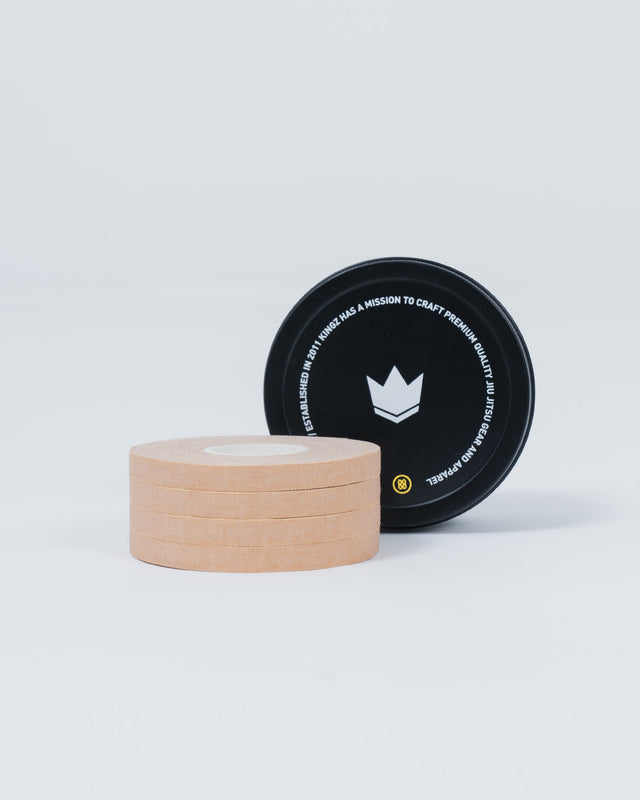
Essential Materials (The Kit)
An important factor, when it comes to finger tape in BJJ is having the right items ready to go. And of course, quality matters here. Why? Obviously, because of a lot of friction and sweat that we always deal with in BJJ. The mats will test everything. A small and smart kit often contains:
-
0.5" or 1" tapes. The rigid athletic tapes made of zinc oxide are usually more practical.
-
A few finger-width pre-cut strips. They save time.
-
Small scissors or a cutter, for cleaning edges and keeping the wrap from bunching.
-
Skin-prep wipes, don’t forget about sweat and friction in BJJ. The combination loosens even the best tape.
-
A tiny pouch or bag to keep it all together (not essential, but helpful).
Some grapplers prefer very stiff tape for a stronger support. You may choose a bit of stretch, especially on a heavy grip day. Both options work well. If the tape stabilizes the joint without locking it completely, that’s it.
Method A: The "X-Wrap" (For Joint Stability)
The X-Wrap is a great method to support the joint without making your finger too stiff. Also, it helps ligaments and protects the knuckle. And, most importantly, it keeps your grips working. A good starting point if you're learning how to tape fingers for BJJ.
Steps for a reliable X-Wrap finger tape for BJJ include:
-
The Anchor: Wrap a tight ring around the proximal phalanx area, the base of your finger, with tape. This secures the tape in its place, which will prevent it from sliding down during training.
-
The Cross: The tape is run diagonally over the knuckle, palm side up, toward the finger tip. Provides side support without restricting finger movement.
-
The Return: Cross back down at an angle to form a clear “X” over the joint. This helps to stabilize the knuckle and limit side-to-side stress.
-
The Lock: Finish with anchor rings top and bottom. Snug, not tight. If your fingertip changes color you've overdone it.
Think of it like rigging a seatbelt for your knuckle: it holds things steady under load and doesn't stop you from using your hand the way you're supposed to.
Method B: The "Buddy Tape" (For Injury Protection)
A popular approach in the BJJ community when a finger feels sore or after a minor tweak is to buddy-tape it to an adjacent finger. Protects the injured joint, still lets you grip.
-
The Concept: Tape the weaker finger to a stronger one, say, the ring finger to the middle finger. The neighboring finger shares the load, takes some stress off the injured side, and makes it harder to re-aggravate.
-
The Spacer: Put a small piece of foam or folded gauze between the two fingers before wrapping. Don't skip this part. Without it, you're setting up skin maceration, basically, your skin softens and breaks down from trapped moisture and constant rubbing. In BJJ, that friction damage opens the door to infections you don't want.
-
The Wrap: Anchor at the base and near the top of both fingers, but keep the joints exposed enough that you can still make a fist. Stability matters here, but so does being able to actually use your hand. The goal is to keep training, not sit out another week.
Buddy taping holds up well after minor sprains or when dealing with finger issues that drag on longer than they should.
Targeted Taping Approaches (Community Practices for Localized Discomfort)
The following techniques are more targeted methods that some experienced grapplers use for specific areas of discomfort (e.g., after a mild hyperextension or known pulley irritation). They are shared as informational community practices only. They are not a substitute for proper medical diagnosis or treatment. If you suspect a pulley strain, capsular injury, or any ongoing issue, consult a sports medicine professional before continuing to train.
The Figure-8 (For Capsular Strain)
Used for instability or pain around the middle knuckle (PIP joint), especially after hyperextension. Restricts angular motion more than a standard X-Wrap.
How to apply:
-
Slight Flexion: Keep the finger slightly bent (~30°) at the middle joint.
-
Anchor: Wrap once around the base, near the palm.
-
The Cross: Run the tape diagonally over the joint, then wrap around the middle knuckle.
-
The Return: Cross back down at an angle, then wrap the base again.
-
Result: Stabilizes the joint, controlling side-to-side stress, while letting you maintain functional grip.
The H-Tape (For Flexor Pulley Strains)
Pulley strains, usually A2 or A4, happen when a loaded grip gets ripped open. Spider guard grips are a common culprit. H-Tape acts like a temporary pulley, reducing tendon bowstringing.
How to apply:
-
Preparation: Cut a strip of rigid tape into an 'H'. The central bridge covers the injured pulley.
-
Placement: Position the bridge over the pulley on the palm side.
-
Functional Flexion: Bend the middle joint to ~60° and hold while applying the tape.
-
Securing Straps: Wrap the far straps first, then the near straps. Maintain the 60° bend.
-
Optional Lock: Add a wrap around the whole setup to prevent sliding during rolls.
These therapeutic techniques are especially useful when you’ve already mastered how to tape fingers for BJJ for general support but need targeted reinforcement. They let you train safely, even with persistent or localized injuries, without sacrificing mobility or grip functionality.
Safety Checks & Troubleshooting
Taping only helps if you do it safely. Good tape applied badly still causes problems; too tight, crooked, left on past when you should've peeled it off. These checks keep things functional.
-
The Capillary Refill Test: Press down on the fingernail, then let go. Color should come back in under two seconds. Takes longer? Too tight. Unwrap it and start over. You need blood flow more than you need support.
-
Range of Motion: Close your hand into a fist. Can you? Does it feel normal when you grip the gi, or does something feel stuck? If the wrap is fighting you, it's too stiff. The point is to stabilize the joint, not turn your finger into a splint.
-
Post-Training Care: Tape comes off right after class. Give your skin some air, then scrub your hands with antimicrobial soap. Skipping this invites irritation and bacterial buildup. Washing matters just as much as wrapping does.
Run these checks every time. Keeps your taping effective, keeps your fingers working, keeps you training long-term.
Bottom Line
Taping fingers is a skill, same as anything else you drill. Takes practice to nail the tension, supporting the joint without choking out your range of motion. Done right, it protects your hands, keeps your grips working, and helps stop small issues from becoming repeat problems.
The goal isn't just getting through today's training. It's making sure you can show up tomorrow, and the day after that, and keep going.
Remember: tape is a helpful tool, not a cure. When in doubt, see a professional.
FAQ: Finger Taping for BJJ
Should I tape my fingers for BJJ?
If your training involves a lot of gripping, heavy drills, multiple rolls, and competition prep, taping can take some load off your ligaments and pulleys. Always listen to your body and consult a professional if anything feels wrong.
What's the best tape for fingers in Jiu-Jitsu?
Rigid athletic tape, half-inch wide, is what most people use. Zinc oxide tape holds well and lasts. Some prefer tape with a bit of flex for longer sessions.
How to correctly tape fingers for BJJ?
Start with a snug anchor around the base of the finger. Pick your method: X-Wrap for general stability, buddy tape if something's hurt. Finish with solid anchors, top and bottom. Check circulation and make sure you can still move before you roll.
Why do people wrap their fingers in BJJ?
Support, mostly. Reduces pain, helps maintain joint health over time. Also gives you a little sensory feedback, reminding you to adjust your grip instead of cranking on it when you shouldn't.
Should I tape proactively or only when something's already hurt?
Taping before issues show up can prevent hyperextensions and overuse problems. Taping after helps manage pain or minor sprains. Depends on how hard you're training and how your hands feel.
How tight should finger tape for BJJ be?
Snug, not tight. Press your fingernail, let go, watch the color come back. Should happen in under two seconds.