

Nouvelles
Comment les instructeurs décident de promouvoir leurs élèves : le parcours en BJJ expliqué

Vous vous entraînez depuis des mois, peut-être des années, et la question reste en suspens : quand vais-je être promu? Les exigences de la ceinture bleue en Jiu-Jitsu ne suivent pas un calendrier. Certaines académies organisent des examens de passage, tandis que d'autres se basent sur ce que les instructeurs observent à l'entraînement au quotidien : vos techniques, votre régularité et votre comportement sur le tatami.
Contrairement aux arts martiaux qui ont des examens rigides et standardisés, le BJJ est subjectif. Ci-dessous, nous expliquons à quelle fréquence vous devriez vous entraîner en BJJ pour passer au niveau suivant.
Ce que les grades signifient vraiment
Les instructeurs utilisent le système de ceintures pour préserver l'intégrité de leur lignée. Quand vous êtes promu, c'est le signe que vous pouvez représenter votre club de façon responsable partout dans le monde.
-
Ceinture bleue : la survie. Vous n'êtes plus une victime et vous savez vous sortir des mauvaises positions de façon fiable.
-
Ceinture violette : la stratégie. Vous ne faites plus que réagir; vous dictez le rythme avec votre propre jeu.
-
Ceinture marron : l'efficacité. Vous avez remplacé la force brute par le levier et le timing.
Les exigences « invisibles »
Votre entraîneur vous observe toujours, surtout pendant ces rounds éreintants du vendredi soir. Il cherche ce qui ne figure sur aucune liste de techniques :
-
L'étiquette sur le tatami : êtes-vous sécuritaire? Un pratiquant qui blesse ses partenaires pour gagner un rolling verra sa progression bloquée, peu importe son talent.
-
La régularité : vous présenter quand vous êtes courbaturé, fatigué ou quand l'effet de nouveauté du sport s'est dissipé. Bien sûr, respectez vos limites et écoutez votre corps.
-
Le leadership : encadrer les ceintures blanches et contribuer à un environnement d'entraînement positif. Aux grades supérieurs, on s'attend à ce que vous éleviez le niveau du groupe, pas seulement à ce que vous y soyez présent.
La ceinture reflète votre caractère autant que votre triangle. Le but est de devenir la personne qui la mérite.
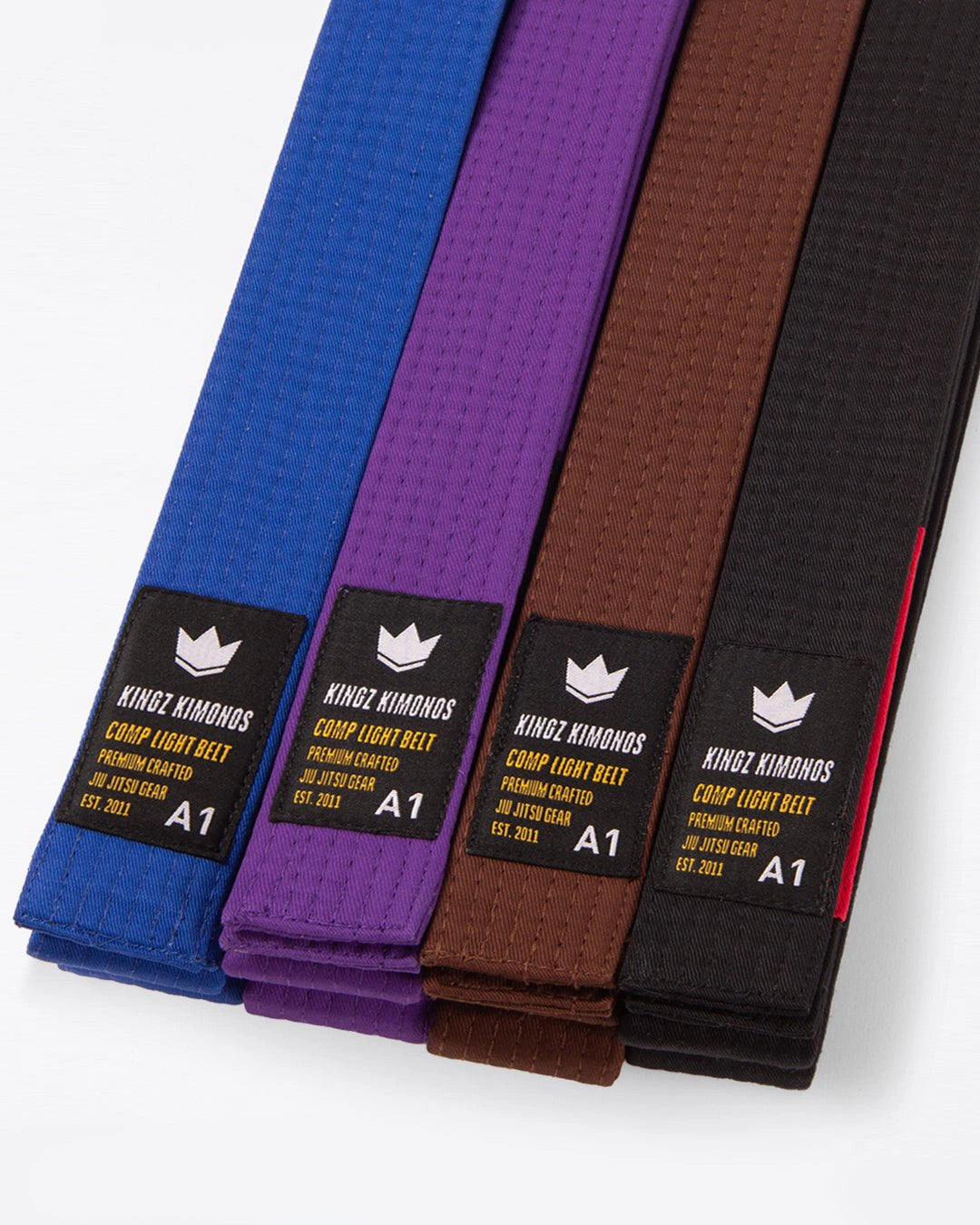
Ceintures prêtes pour la compétition | Kingz™
Nouez votre progression
MagasinerLa première grande étape : les exigences de la ceinture bleue en Jiu-Jitsu
Obtenir votre ceinture bleue est le premier vrai obstacle. C'est le moment où vous cessez d'être un passager affolé pour commencer à agir en pilote. Pour un entraîneur, la compétence ne consiste pas à être un athlète de calibre mondial, mais à prouver que vous connaissez assez bien l'alphabet du sport pour commencer à écrire vos propres phrases.
La survie : l'étoile polaire
L'essentiel des exigences de la ceinture bleue en BJJ n'est pas votre taux de soumission, mais à quel point vous êtes difficile à finir. Un instructeur doit voir que, lorsque vous êtes écrasé sous un contrôle latéral lourd ou coincé dans une montée serrée, vous ne paniquez pas. Vous avez les sorties nécessaires pour revenir en sécurité.
Les bases techniques
Vous n'avez pas besoin du berimbolo, mais vous devez maîtriser les bases :
-
Les mouvements de mobilité : le shrimp, le pont et le relevé technique doivent être instinctifs, puisqu'ils sont l'ADN de chaque sortie.
-
La lecture des positions : vous devez comprendre la hiérarchie du tatami. Vous devez savoir pourquoi prendre le dos est l'objectif et pourquoi le contrôle latéral n'est qu'une étape.
-
Les « trois grands » : armlock, triangle et kimura. Vous devez en comprendre la mécanique, pas seulement les placer, en utilisant le levier plutôt que les muscles.
Le sens du tatami et le timing
Les ceintures blanches ont besoin d'être guidées, car elles ne savent pas encore coordonner leurs mouvements. À la ceinture bleue, cette énergie désordonnée devrait se calmer. Vous apprenez quand exploser et, surtout, quand respirer.
Le long chemin de 18 mois
Même si l'IBJJF n'impose pas de durée minimale à la ceinture blanche, en pratique, la plupart des grapplers y passent de 1,5 à 2 ans. C'est long, tout en bas de la chaîne alimentaire. Si vous vous sentez bloqué, commencez un journal d'entraînement. Noter un renversement hip bump réussi ou une sortie propre vous apporte l'entretien mental dont vous avez besoin pour rester motivé.
Passer au niveau intermédiaire : les exigences de la ceinture violette en BJJ
Si la ceinture bleue consiste à survivre à la tempête, la ceinture violette est celle où vous commencez à contrôler le rythme. C'est le grade intellectuel.
L'architecte du jeu
Le plus grand changement dans les exigences de la ceinture violette en BJJ est le passage de la connaissance des techniques à un véritable jeu. Vous devriez avoir un style signature à ce stade, que vous soyez un joueur de garde impossible à passer ou un passeur de pression qui excelle dans l'usure lente.
-
La reconnaissance des schémas : plus rien ne vous surprend. Vous sentez un renversement venir trois étapes à l'avance et vous avez déjà la riposte prête.
-
Les enchaînements de soumissions : vous ne chassez pas qu'un seul armlock; vous attaquez en séquences. Si l'adversaire défend A, vous êtes déjà passé à B et à C.
-
L'efficacité plutôt que l'effort : une ceinture violette doit pouvoir gérer une ceinture blanche très intense sans se mettre dans le rouge, en utilisant la répartition du poids et le timing plutôt que la force brute.
Le rôle de mentor
Ce n'est pas pour rien qu'on surnomme souvent les ceintures violettes des « instructeurs juniors ». Vous avez la profondeur technique nécessaire pour réellement aider ceux qui vous suivent.
Les entraîneurs observent comment vous traitez le groupe. Pouvez-vous expliquer un renversement en ciseaux à un nouveau frustré? Pouvez-vous faire du rolling avec un partenaire plus petit sans l'écraser? Encadrer les autres prouve à votre entraîneur que vous comprenez enfin le pourquoi derrière le comment.
L'horizon de 1,5 à 5 ans
Le chemin vers la ceinture violette varie selon votre fréquence d'entraînement et vos objectifs. Le minimum de l'IBJJF est de 1,5 an à la ceinture blanche, mais les compétiteurs ou ceux qui se concentrent sur les tournois peuvent prendre plus de temps pour peaufiner leur jeu. Pour la plupart des pratiquants réguliers, la promotion peut arriver en 1,5 à 2 ans environ, et la progression se mesure non pas en pas de géant, mais en petites améliorations successives de vos positions préférées.
L'adaptabilité et la présence
La ceinture violette est le moteur fiable du club. Vous devez pouvoir vous adapter à tout le monde : le lutteur de 250 lb, l'adolescent souple ou le pratiquant plus âgé qui s'entraîne pour le plaisir. Votre présence doit avoir un effet apaisant et prouver que vous gardez votre sang-froid même quand un rolling devient intense.
À ce grade, vous n'êtes plus seulement un élève; vous êtes un pilier de l'académie. Vous avez prouvé que vous n'êtes pas de passage dans ce sport : vous y avez emménagé.
La variable de la régularité : à quelle fréquence devriez-vous vous entraîner en BJJ?
La question de la fréquence est celle où beaucoup de parcours en BJJ décollent ou frappent un mur. Atteindre votre prochain grade dépend davantage d'un rythme durable que d'un sprint à court terme.
La base de « 3 jours »
Pour la plupart des instructeurs, trois séances par semaine est le chiffre magique. C'est une fréquence suffisante pour garder votre mémoire musculaire active sans épuiser votre capacité de récupération. À ce rythme, vous faites environ 150 séances par année, un volume solide qui vous permet d'intégrer les exigences de la ceinture bleue tout en laissant du repos à vos articulations.
-
1 à 2 jours par semaine : le mode entretien. La progression est lente, puisque vous passez la moitié de chaque cours à vous rappeler ce que vous avez fait la semaine précédente.
-
3 à 4 jours par semaine : la zone idéale. Cela mène généralement à la ceinture bleue dans la fenêtre habituelle de 1,5 à 2 ans.
-
5 jours ou plus par semaine : la voie du compétiteur. L'acquisition des compétences est plus rapide, mais le risque d'épuisement ou de blessure grimpe en flèche.
La qualité avant la quantité
Il est facile de devenir un fantôme du tatami, présent physiquement mais absent mentalement. Les instructeurs remarquent qui s'exerce vraiment avec intention. Deux séances concentrées où vous cherchez activement à régler un passage de garde valent souvent mieux que cinq rounds sur le pilote automatique.
Trouver l'équilibre dans l'effort
Votre fréquence d'entraînement dépend beaucoup de l'entretien de votre propre corps. Un athlète de 20 ans et un professionnel de 40 ans n'ont pas les mêmes besoins de récupération. Les instructeurs ne comptent pas seulement les heures; ils recherchent la régularité. Ils veulent voir que vous faites partie intégrante de la culture du club, peu importe votre total hebdomadaire.
Le pouvoir de la communication
Si vous avez des objectifs précis, comme atteindre les exigences de la ceinture violette d'ici une certaine année, parlez-en à votre entraîneur. Être honnête l'aide à vous soutenir pendant les plateaux qui surviennent quand vous réalisez à quel point le Jiu-Jitsu est vraiment difficile.
La dure réalité : pourquoi l'attente compte
Si vous vous êtes déjà demandé si le Jiu-Jitsu est difficile, la réponse est oui. Mais cette difficulté n'est pas un défaut du système; c'est justement ce qui donne sa valeur à la ceinture.
Les instructeurs maintiennent souvent volontairement un élève à son grade, même après qu'il a coché toutes les cases techniques. Voici pourquoi l'attente compte :
-
La préparation mentale : une nouvelle ceinture fait de vous une cible. Une promotion précipitée peut dépasser un élève face à la pression accrue et aux attentes plus élevées de ses partenaires d'entraînement.
-
L'épreuve de la pression : vous avez besoin d'assez d'heures sur le tatami pour dépasser les techniques apprises par cœur et développer des réactions instinctives. L'attente garantit que vos sorties fonctionnent quand vous êtes épuisé, pas seulement quand vous êtes frais.
-
La voie du loisir ou celle du compétiteur : même si l'or en tournoi n'est pas exigé de tout le monde, les instructeurs regardent comment vous gérez le stress.
-
La leçon d'humilité : le BJJ est un marathon de répétitions. Les longues attentes entre les grades reflètent l'art lui-même : la maîtrise ne se précipite pas.
Bref, les parties difficiles du parcours sont conçues pour forger le caractère nécessaire aux grades supérieurs.
Le jeu à long terme : ceinture marron et ceinture noire
La plupart des gens abandonnent bien avant de voir la ceinture marron. À ce stade, vous ne collectionnez plus les techniques; vous éliminez le superflu.
-
Ceinture marron : c'est une question d'efficacité. Vous avez investi de 5 à 8 ans. Vous ne forcez plus; vous utilisez de petits ajustements de la pression des hanches pour faire le travail.
-
Ceinture noire : généralement après environ 10 ans, mais parfois plus ou moins. Ce n'est pas la fin, c'est simplement le moment où vous comprenez enfin comment tout le système s'emboîte. Vous êtes maintenant un leader au club, et on s'attend à ce que vous aidiez tout le monde à résoudre leurs problèmes.
|
Grade |
L'objectif |
|
Bleue |
Cesser d'être une victime. Maîtriser les exigences de la ceinture bleue. |
|
Violette |
Développer un jeu. Atteindre les exigences de la ceinture violette. |
|
Marron |
Tout raffiner. Colmater les failles de votre jeu. |
|
Noire |
Enseigner. Diriger. Continuer à se présenter. |
En résumé
Ne courez pas après la ceinture. Si vous passez chaque round à vous demander quand vous aurez votre prochaine barrette, vous passez à côté de l'essentiel. La ceinture n'est qu'une conséquence des heures investies quand il fait chaud au club, que votre corps est courbaturé et que personne ne regarde.
Faites confiance à votre entraîneur. Il voit les petits détails, comme la façon dont vous avez enfin relâché votre prise ou êtes resté calme dans une mauvaise position. Concentrez-vous sur le fait d'être un bon partenaire et sur l'amélioration de votre technique. La promotion viendra au bon moment. Gardez simplement votre ceinture nouée et restez sur le tatami.
FAQ
Quelles sont les exigences de la ceinture bleue en Jiu-Jitsu?
C'est essentiellement la phase « survivre ». Votre entraîneur veut voir que vous pouvez vous sortir des mauvaises positions, savoir où vous êtes sur le tatami et placer des soumissions de base comme l'armlock ou le triangle sans forcer.
Combien de temps faut-il pour obtenir la ceinture violette?
Il n'y a pas d'échéancier fixe. Le minimum de l'IBJJF est de 1,5 an à la ceinture bleue, mais le moment réel dépend de votre régularité, de votre fréquence d'entraînement et de vos objectifs, surtout si vous faites souvent de la compétition.
À quelle fréquence devriez-vous vous entraîner pour obtenir une promotion?
Trois jours par semaine est le chiffre magique pour la plupart des gens. C'est assez pour ne pas rouiller, sans que vos articulations crient grâce. La régularité compte plus qu'un sprint occasionnel de cinq jours suivi de deux semaines d'arrêt.
Le Jiu-Jitsu est-il difficile pour les débutants?
Oui. C'est épuisant et ça peut faire mal à l'ego. Mais c'est justement le filtre. La difficulté est exactement ce qui forge la résilience dont vous aurez besoin quand ce sera vous que tout le monde voudra battre.
Puis-je sauter une ceinture si je suis un athlète naturel?
Non. Les qualités athlétiques peuvent vous aider à gagner des rounds, mais elles ne remplacent pas le temps sur le tatami. Vous devez quand même investir les heures nécessaires pour développer le timing et la profondeur technique que représente une ceinture.
La compétition accélère-t-elle les choses?
Elle le peut, surtout parce que la compétition est un test de stress à haute vitesse qui vous oblige à corriger vos erreurs rapidement. Mais un entraîneur regarde aussi comment vous traitez vos partenaires d'entraînement et si vous vous présentez vraiment quand il n'y a aucune médaille en jeu.
Quel est le saut entre la ceinture marron et la ceinture noire?
La ceinture marron consiste à éliminer le superflu et à colmater les petites failles de votre jeu. À la ceinture noire, vous n'êtes plus seulement un élève; vous êtes un leader.