

Nouvelles
Jiu-Jitsu japonais : les principales différences avec le Jiu-Jitsu brésilien

Pour quiconque monte sur le tatami pour la première fois, l'univers du Jiu-Jitsu peut ressembler à un labyrinthe de termes et de techniques. Deux styles se démarquent : le Jiu-Jitsu japonais (JJJ) et le Jiu-Jitsu brésilien (BJJ). Les deux remontent à la même lignée ancienne, mais leurs chemins et leurs objectifs ont divergé.
Cet article s'adresse aux pratiquants qui respectent l'art et veulent comprendre ce qui rend chaque style unique. Que vous soyez nouveau dans les arts martiaux ou bien avancé dans votre parcours en BJJ, explorer l'héritage des deux a beaucoup à vous apporter.
À retenir
- Les samouraïs ont développé le Jiu-Jitsu japonais comme un art martial traditionnel axé sur le combat et l'autodéfense pratique.
- Le Jiu-Jitsu brésilien (BJJ) est issu du Jiu-Jitsu japonais (JJJ) et met l'accent sur le combat au sol et la compétition sportive.
- Le JJJ intègre les frappes, les projections, les clés articulaires et la défense contre les armes; le BJJ intègre le levier et le grappling de soumission.
- Les deux arts comptent différents styles et approches, ce qui reflète la diversité et les caractéristiques propres à chaque système.
- Chaque style offre une philosophie, une approche de l'entraînement et une expérience culturelle différentes.
- Les deux systèmes favorisent la discipline, le respect et l'apprentissage tout au long de la vie.
Un bref historique du Jiu-Jitsu
Des origines dans le Japon féodal
Le Jiu-Jitsu est imprégné de la tradition des samouraïs. Ses racines remontent à plusieurs siècles, dans le Japon féodal. Le Jiu-Jitsu japonais (jujutsu, parfois écrit jujitsu ou ju jitsu) a d'abord été développé pour le champ de bataille. Il permettait aux samouraïs de combattre efficacement une fois désarmés. Les pratiquants ont peu à peu raffiné ces techniques en systèmes appelés koryu jujutsu, des écoles anciennes qui mettaient l'accent sur l'efficacité, le contrôle et la survie.
Ces systèmes ne servaient pas seulement à gagner un combat. Ils visaient à préserver la vie et à honorer le code du guerrier, le bushido. Beaucoup d'écoles avaient leurs propres interprétations et techniques, transmises de génération en génération par des pratiquants dévoués.
L'essor du koryu jujutsu
Les pratiquants ont préservé le système du Jiu-Jitsu par l'enseignement oral et la pratique directe, ce qui en faisait un savoir très personnel. Chaque école, comme le Daito Ryu, le Daito Ryu Aiki Jutsu (qui a beaucoup influencé d'autres arts martiaux comme l'aïkido), le Tenshin Shoden Katori Shinto Ryu ou le Shindo Yoshin Ryu, a développé ses propres méthodes selon l'environnement et les besoins pratiques de l'époque. Cela a rendu le Jiu-Jitsu japonais extrêmement riche et nuancé.
En évoluant, le jujutsu japonais a vu des écoles modernes intégrer des méthodes et des techniques d'entraînement contemporaines. Elles ont été influencées par des arts martiaux comme le karaté d'Okinawa et le karaté Shotokan. Ces échanges ont façonné le développement du jujutsu japonais et l'ont distingué à la fois de ses racines traditionnelles et des autres disciplines martiales.

Les influences modernes et l'évolution
Du Japon au Brésil

La terminologie japonaise en JJJ et en BJJ
Termes généraux :
- Jiu-Jitsu / Jujutsu (柔術) : « l'art doux » ou « l'art de la souplesse », qui renvoie à la philosophie de base consistant à utiliser la force de l'adversaire contre lui.
- Dojo (道場) : la salle d'entraînement.
- Gi (着) : l'uniforme d'entraînement traditionnel, le kimono, porté en JJJ comme en BJJ.
- Tatami (畳) : les tapis de paille utilisés dans les dojos japonais traditionnels.
- Sensei (先生) : l'enseignant ou l'instructeur.
- Rei (礼) : le salut, utilisé pour montrer son respect avant et après l'entraînement.
Les techniques du Jiu-Jitsu japonais
Le JJJ est un système de combat complet. Il comprend :
- Les techniques de grappling : contrôler l'adversaire par des projections, des immobilisations et des amenées au sol.
- Les techniques de frappe : coups de poing, de coude, de genou et de pied.
- Les clés articulaires : appliquer une pression sur les articulations pour immobiliser ou forcer l'abandon.
- Les soumissions : clés de bras, clés de jambe et étranglements pour contrôler ou soumettre un adversaire.
- Les clés de jambe : des soumissions spécialisées qui ciblent les jambes.
- L'entraînement aux armes : à la fois leur utilisation et la défense contre des armes comme les couteaux et les sabres.
Les pratiquants considèrent le Jiu-Jitsu japonais comme un système d'autodéfense complet qui intègre un large éventail de techniques. Il couvre le combat à mains nues et ses méthodes, ainsi que la défense contre les frappes, ce qui le rend très adaptable aux situations réelles.
En JJJ, les instructeurs simulent souvent des scénarios d'attaque et de combat imprévisibles, comme plusieurs attaquants, la défense contre un couteau ou contre une personne armée d'une lame. Le but est de s'assurer que les techniques fonctionnent dans la réalité. L'entraînement comprend aussi des techniques dangereuses, voire mortelles, ainsi que l'utilisation de points de pression pour contrôler ou neutraliser.
Les instructeurs poussent les pratiquants à s'entraîner intensément et à bouger avec précision, efficacité et contrôle. Ce n'est pas pour rien que le JJJ est resté pertinent malgré des siècles d'évolution des arts martiaux : il vous prépare à l'imprévu.
Il accorde aussi une grande importance à la maîtrise de l'agressivité. Les instructeurs enseignent les techniques avec un code moral strict, en guidant les élèves sur le moment d'éviter un conflit et la façon d'y faire face. Ce sens des responsabilités fait partie de l'attrait du JJJ.
Les techniques du Jiu-Jitsu brésilien
Même si le Jiu-Jitsu brésilien partage ses racines avec le Jiu-Jitsu japonais, il a suivi un chemin différent. Le BJJ met l'accent sur le combat au sol et apprend aux pratiquants à amener l'adversaire au sol, à passer la garde, à réussir des renversements et à appliquer des soumissions comme les étranglements, les clés articulaires et des techniques comme l'americana en BJJ. On le considère comme un style de combat au sol, et il comprend une variante populaire appelée BJJ No-Gi, qui enseigne le grappling sans le kimono traditionnel.
Les pratiquants s'entraînent au BJJ dans un cadre sportif, avec du sparring en situation réelle (le rolling). Les règles de compétition du BJJ façonnent la façon de s'entraîner et encouragent la créativité, la fluidité et la domination positionnelle. Les clubs de BJJ sont de véritables lieux de rassemblement où les pratiquants perfectionnent leur combat au sol et leurs soumissions.
Un autre trait distinctif du BJJ est l'importance de la technique sur la force. Les pratiquants s'entraînent souvent à vaincre des adversaires plus grands et plus forts grâce au levier, au positionnement et au timing. Cela le rend très attrayant pour les personnes de tous les gabarits, de tous les âges et de tous les niveaux d'expérience.
Le BJJ et le JJJ diffèrent dans leurs méthodes d'entraînement. L'entraînement en BJJ repose souvent sur le sparring et les exercices, alors que le JJJ peut se concentrer davantage sur les katas et des routines structurées. Les deux arts font toutefois du grappling un élément central de leur pratique.
Les séances de rolling aident les élèves à apprendre rapidement. Les erreurs deviennent des leçons, et la rétroaction est immédiate. C'est l'une des raisons pour lesquelles on décrit souvent le BJJ comme des échecs physiques : il vous apprend à réfléchir sous pression.
Le Jiu-Jitsu brésilien et le JJJ ont des similitudes importantes, surtout leur intérêt commun pour le grappling et l'utilisation de soumissions comme les étranglements et les clés articulaires. Chaque art offre néanmoins sa propre philosophie et sa propre approche de l'entraînement, ce qui en fait deux voies distinctes dans le monde des arts martiaux.
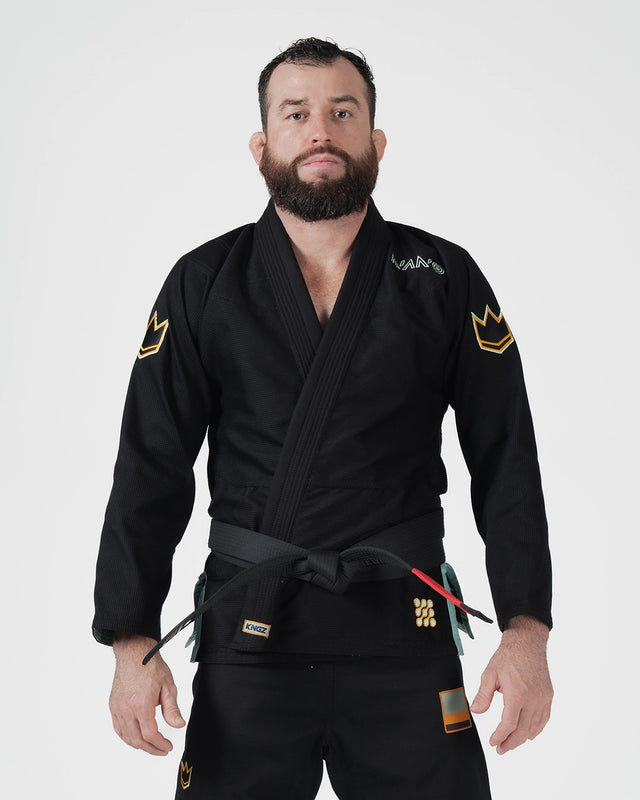
Approuvé IBJJF à 100% | KiNGZ™
Veste Pearl Weave 380 GSM - pantalon en ripstop 270 GSM
MagasinerChoisir le bon équipement pour votre parcours
Si vous commencez votre parcours en arts martiaux, le mouvement, l'état d'esprit et la régularité sur le tatami comptent beaucoup plus que l'équipement. Le développement technique doit toujours passer en premier, surtout au début. Avec le temps, toutefois, le bon équipement peut contribuer à votre confort et vous permettre une pratique plus concentrée.
Un kimono ou un ensemble No-Gi bien ajusté favorise la mobilité et réduit les distractions pendant les exercices et le sparring. Beaucoup de pratiquants recherchent des vêtements d'entraînement faits de matériaux durables, avec une coupe fonctionnelle qui résiste à un usage régulier. Les kimonos pour hommes, le No-Gi pour hommes, les kimonos pour femmes et le No-Gi pour femmes sont des choix courants pour leur équilibre entre confort, durabilité et liberté de mouvement pendant l'entraînement.

Les styles et systèmes de combat
Le Jiu-Jitsu japonais est un style de combat très adaptable. Un instant, vous vous défendez contre un coup de sabre; le suivant, vous appliquez une clé de poignet pour arrêter un attaquant désarmé. Les instructeurs enseignent un système qui couvre la frappe, le grappling et tout ce qui se trouve entre les deux, souvent en présentant les techniques sous forme d'enchaînements.
Les élèves apprennent à répondre à une attaque, puis à enchaîner avec des techniques de suivi selon la situation. Ce système en couches reflète la profondeur et la diversité du JJJ, qui englobe un large éventail de techniques et d'influences historiques. Cette approche est idéale pour développer la pensée stratégique et des réflexes rapides.
Le BJJ, lui, est plus spécialisé. Sa force réside dans sa profondeur, surtout pour le grappling au sol. Cela dit, beaucoup d'écoles de BJJ modernes ont commencé à intégrer des exercices d'amenées au sol et du grappling debout, reconnaissant l'importance d'une autodéfense complète.
L'influence japonaise sur le BJJ
Le Jiu-Jitsu japonais a fortement influencé le Jiu-Jitsu brésilien. En tant qu'art japonais classique, il mettait l'accent sur l'autodéfense, les techniques de champ de bataille et des principes philosophiques. De la terminologie (« jujutsu », « kuzushi », « osaekomi ») à l'importance de la technique sur la force, le BJJ porte un fort héritage japonais. La transmission du Jiu-Jitsu et des techniques japonaises au Brésil a jeté les bases de ce qui allait devenir le BJJ moderne.
Le BJJ tire une grande partie de sa structure de base directement de ses racines japonaises, notamment son système de ceintures, l'importance accordée à la discipline et de nombreuses techniques de soumission. Les premiers pratiquants Gracie ont appris auprès de Mitsuyo Maeda, un judoka japonais, puis ont modifié les techniques selon leurs propres besoins. Le jujutsu japonais a servi de fondation à ces adaptations en fournissant les principes et les techniques de base qui ont évolué pour devenir le BJJ, y compris des clés d'épaule comme l'omoplata en BJJ.
L'influence s'étend même à l'étiquette du BJJ. Saluer en montant sur le tatami et en le quittant, respecter les instructeurs et utiliser une terminologie japonaise pour certaines techniques (comme sankaku pour le triangle) rappellent tous l'héritage du BJJ. Le rôle de l'étiquette et du respect à l'entraînement se reflète souvent dans des traditions comme le OSS en BJJ, qui soulignent la discipline au sein du Jiu-Jitsu brésilien.
Avec le temps, le BJJ a développé sa propre identité. Les pratiquants modernes ont développé des techniques comme le berimbolo, la garde De La Riva et la garde inversée, ainsi que des systèmes comme la K guard en BJJ, des innovations absentes du jujutsu japonais traditionnel. L'orientation sportive, le système de ceintures et l'intensité de l'entraînement le distinguent aussi.
Les principales différences d'entraînement
- L'entraînement en Jiu-Jitsu japonais comprend souvent des katas (formes préétablies), des frappes et du travail avec armes. Il met l'accent sur la discipline, la tradition et le conditionnement de tout le corps. Les instructeurs guident les élèves dans une progression de ceintures structurée, des ceintures de couleur jusqu'à la ceinture noire, symbole de maîtrise et d'expertise. Les ceintures noires sont très respectées, et le système de grades occupe une place importante dans la structure des cours. Les élèves plus gradés se sont familiarisés avec la terminologie japonaise et ont constaté que les termes d'origine avaient plus de sens que leurs traductions.

- L'entraînement en Jiu-Jitsu brésilien comprend le rolling, le sparring positionnel et la préparation à la compétition. Il est très itératif et se concentre souvent sur une seule position ou une seule soumission pendant toute une séance. Les instructeurs de BJJ accordent une grande importance à la progression des ceintures, la ceinture noire symbolisant une maîtrise avancée et un haut niveau technique. La communauté reconnaît la maîtrise des ceintures noires, qui jouent souvent un rôle clé dans l'enseignement et la promotion des autres élèves.
Le BJJ offre généralement plus d'occasions de tester les techniques en situation réelle. Le rolling est au cœur de chaque cours, et les élèves apprennent vite par essais et erreurs. Le JJJ, en revanche, peut comprendre davantage d'exercices avec partenaire et moins de résistance au début, le sparring étant introduit progressivement.
Un cours typique de JJJ peut commencer par un échauffement, suivi du kihon (les fondamentaux), de la pratique des katas et d'exercices d'autodéfense. Un cours de BJJ, lui, peut se concentrer sur une seule technique ou position, suivie de plusieurs rounds de rolling pour en tester l'application.

L'importance culturelle du JJJ
La reconnaissance mondiale du Jiu-Jitsu japonais et du Jiu-Jitsu brésilien
Foire aux questions
Quelle est la principale différence entre le Jiu-Jitsu japonais et le Jiu-Jitsu brésilien?
Le Jiu-Jitsu japonais est-il efficace pour l'autodéfense?
Lequel est le meilleur pour les débutants, le BJJ ou le JJJ?
Puis-je m'entraîner à la fois en BJJ et en JJJ?
Le BJJ est-il plus facile à trouver que le JJJ?
Le Jiu-Jitsu japonais comprend-il du combat au sol?
Quel rôle joue la tradition dans le Jiu-Jitsu japonais?
Y a-t-il une différence de condition physique entre le JJJ et le BJJ?
Conclusion
L'un met l'accent sur la tradition et le combat global; l'autre se spécialise dans le contrôle au sol et la compétition. Aucun n'est meilleur; ils sont simplement différents. Le meilleur choix dépend de vos objectifs.
Le parcours en BJJ et en JJJ mettra votre corps à l'épreuve et façonnera votre esprit. Vous y gagnerez discipline, résilience et un respect plus profond pour la voie martiale.
Choisissez celui qui correspond à votre chemin et entraînez-vous toujours avec humilité.